
Kako komplet središnjeg venskog katetera postiže medicinske svrhe kroz sinergiju različitih komponenti?
Analiza temeljnih komponenti kompleta
A komplet središnjeg venskog katetera Sadrži različite ključne komponente, od kojih svaka igra jedinstvenu i nezamjenjivu ulogu u cijelom procesu medicinskog operacije. Prvi je središnji venski kateter, što je jezgra komponenta kompleta i je kanal koji povezuje središnju venu izvan tijela i unutar tijela. Njegov je materijal obično izrađen od poliuretana ili silikona medicinskog razreda. Takvi materijali imaju dobru biokompatibilnost i mogu učinkovito smanjiti tijelo odbacivanja stranih tijela i smanjiti rizik od komplikacija poput infekcije. Različite vrste središnjih venskih katetera imaju svoje karakteristike u strukturi i funkciji. Kateteri s jednim lumenom prikladni su za potrebe za pojedinačnim liječenjem, dok kateteri s dvostrukim lumenom ili multi-lumenom mogu istovremeno izvoditi različite medicinske operacije, poput infuzije, prikupljanja krvi i primjene lijekova, što uvelike poboljšava učinkovitost i praktičnost medicinskih operacija. U pogledu dizajna, neke površine katetera tretiraju se posebnim premazima kako bi se dodatno poboljšala anti-thbotička svojstva; Neki su također označeni vagama kako bi se medicinsko osoblje olakšalo kako bi precizno shvatili dubinu umetanja.
A cannula plays a pioneering role in the central venous catheter kit. When performing a central venous catheter insertion operation, the cannula is first used for percutaneous puncture into the vein. Its needle tip adopts a bevel cutting process. This design is sharp and precise, and can quickly and accurately penetrate the skin and vein wall with minimal resistance, opening a channel for the entry of subsequent components. The needle core and outer sleeve of the cannula needle are closely matched. When the cannula needle successfully enters the vein, the inner needle core is removed through a special separation mechanism, and the outer sleeve with a certain hardness and flexibility will remain in the vein as a guide channel for subsequent guide wires and other components to enter. To ensure the accuracy of puncture, some cannula needles are also equipped with ultrasound guidance adapters, which can be used with ultrasound equipment to observe the puncture path and blood vessel status in real time.
A guidewire is a key tool for precise positioning and guidance in the central venous catheter kit. After the cannula needle establishes the initial channel, the guidewire will be sent into the vein through the cannula. The outer layer of the guidewire is usually woven from medical-grade stainless steel wire, and the inner layer is a nickel-titanium alloy core. This structure gives the guidewire good flexibility and maneuverability. Doctors can use the J-shaped or straight head design of the guidewire tip to flexibly turn and guide it in the blood vessel through in vitro operation, and accurately send it to the target position. Some high-end guidewires also have a hydrophilic coating, which becomes lubricated after contact with blood, further reducing friction damage to the inner wall of the blood vessel. The existence of the guidewire makes the insertion path of the central venous catheter clearer and more controllable, laying a solid foundation for the smooth insertion of the subsequent catheter.
A role of the dilator in the central venous catheter kit should not be ignored. Since the diameter of the vein is relatively thin, and the central venous catheter needs to be smoothly inserted, it is necessary to properly dilate the vein. The dilator usually adopts a conical or cylindrical design, and the material is mostly medical-grade polyethylene. It can enter the vein along the guidewire and expand the channel of the venous puncture site by gradually expanding. During the expansion process, the smooth surface treatment and gradual caliber design of the dilator can reduce damage to the venous tissue while ensuring effective expansion. For special patients, such as those with thin blood vessel walls or sclerosis, there are also special controllable dilators available, and doctors can accurately adjust the expansion strength and range according to actual conditions.
A peelable sheath is an important part of the central venous catheter kit to ensure the safe insertion of the catheter. After the dilator completes the dilation of the vein, the peelable sheath will be sent into the vein along the guidewire and dilator. The peelable sheath consists of two symmetrical half sheaths connected by a special locking structure in the middle. When the peelable sheath reaches the appropriate position, the central venous catheter will be inserted into the vein through the sheath. At this time, the medical staff will separate the peelable sheath from the middle lock and remove it from the body through a specific operation technique, while the central venous catheter will be left in the vein. This unique design not only ensures the smooth catheter insertion process, but also avoids unnecessary damage to the vein and catheter. To prevent accidental scratches on the surrounding tissue when the sheath is peeled off, the edge of the sheath is specially rounded and blunted.
A fixing device plays a role in stabilizing and fixing the catheter in the central venous catheter kit. In order to ensure that the central venous catheter can maintain a stable position in the patient's body for a long time without displacement or falling off, fixing devices such as sutures, sterile dressings or special catheter fixers will be used to fix the catheter to the patient's skin. The suture fixation method is suitable for patients with long-term catheterization. The catheter is fixed to the skin tissue through delicate suturing operations; the sterile dressing is breathable, waterproof and antibacterial, and can effectively protect the puncture site; the dedicated catheter fixator is made of medical-grade silicone or polymer materials, and can be personalized according to the patient's skin morphology and catheter model through an adjustable buckle design. Appropriate fixation can not only ensure the normal function of the catheter, but also reduce the discomfort and potential risks caused to the patient by the movement of the catheter.
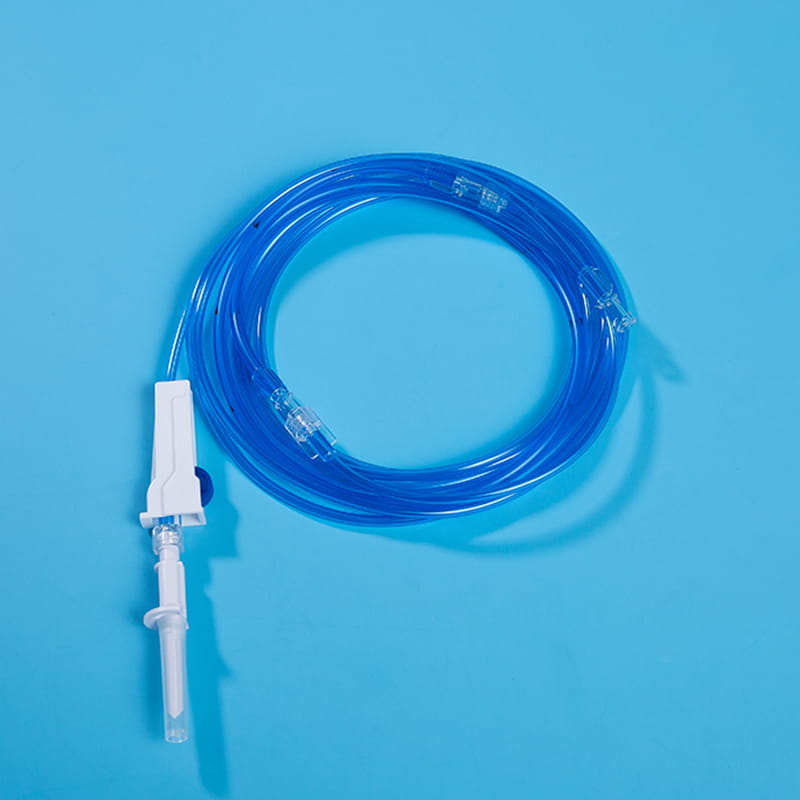
A interface for external connection is the bridge between the central venous catheter and external medical equipment. Through these interfaces, the central venous catheter can be connected to infusion sets, syringes and other equipment to achieve various medical operations such as infusion, drug administration, and blood collection. The design of these interfaces has good sealing and compatibility, and common ones include Luer connectors and needleless infusion connectors. The Luer connector is connected by threads to ensure a tight connection without leakage; the needleless infusion connector adopts a diaphragm design, which can complete the infusion operation without acupuncture, reducing the risk of infection. At the same time, some interfaces also have anti-backflow function to prevent blood from reflux and blocking the catheter, and support multiple devices to be connected at the same time to meet complex clinical needs.
Širok raspon scenarija kliničkih primjena
U stvarnim medicinskim primjenama, scenariji upotrebe setova središnjeg venskog katetera vrlo su široki. U području intenzivne njege, za pacijente s kritičnim stanjima kojima je potrebna velika količina infuzije i čestih lijekova, središnji venski kateteri mogu pružiti brzu i stabilnu infuzijsku kanal kako bi zadovoljili potrebe pacijenata za tekućine i lijekove. Uzimajući bolesnike sa septičkim šokom kao primjer, tijekom procesa spašavanja, veliku količinu kristaloidne tekućine, koloidne tekućine i vazoaktivnih lijekova potrebno je nadopuniti u kratkom vremenu. Središnji venski kateter može osigurati da ove tekućine i lijekovi brzo uđu u cirkulaciju krvi i brzo ispravljaju udarno stanje. Istodobno, hemodinamičko praćenje može se provesti i kroz središnji kateter vena. Liječnik povezuje senzor tlaka na sučelje katetera kako bi dobio parametre poput središnjeg venskog tlaka i tlaka klina plućne arterije u stvarnom vremenu, što pomaže liječnicima da razumiju pacijentovu funkciju srca i status cirkulacije krvi u stvarnom vremenu i pruža važnu osnovu za formuliranje točnih planova liječenja.
U liječenju tumora, mnogi lijekovi za kemoterapiju vrlo su iritantni na krvne žile, a primjena kroz periferne vene može uzrokovati komplikacije poput flebita. Komplet središnjeg venskog katetera može staviti kateter u središnju venu, omogućujući lijekovima s kemoterapijom da izravno uđu u velike krvne žile i brzo se razrijeđuju, smanjujući na taj način iritaciju krvnih žila, smanjujući vjerojatnost komplikacija i poboljšati toleranciju i poštivanje pacijenata. Na primjer, pacijenti s karcinomom dojke koji primaju visoko iritantne lijekove za kemoterapiju poput doksorubicina mogu koristiti središnje venske katetere kako bi učinkovito izbjegli ozbiljne posljedice poput nekroze kože i ulceracije tkiva uzrokovane ekstravazacijom lijekova. Istodobno, za pacijente kojima je potrebna dugotrajna i višestruka kemoterapija, središnji venski kateteri smanjuju bol od opetovanih proboja i poboljšavaju kontinuitet liječenja.
Pored toga, u prehrambenoj terapiji za podršku, središnji venski kateteri mogu se koristiti za potpunu podršku parenteralne prehrane za pacijente koji ne mogu prehraniti dovoljno prehrane kroz gastrointestinalni trakt, kao što su bolesnici s dugoročnom komom i teškim opeklinama. Dajući visoku koncentraciju, visokokalorično hranjiva otopina kroz središnju venu može zadovoljiti potrebe pacijentovog tijela za hranjivim tvarima i promicati pacijentov oporavak. Uzimajući bolesnike s opsežnim opeklinama kao primjer, njihova gastrointestinalna funkcija potisnuta je zbog traume i ne mogu normalno probaviti i apsorbirati hranu. U ovom se trenutku sveobuhvatna otopina hranjivih tvari koja sadrže aminokiseline, masna emulzija, glukoza i drugi sastojci daju se kroz središnji venski kateter za održavanje pacijentove ravnoteže dušika, nadopunjavanje energije koju je tijelo zahtijevalo i ubrzalo zacjeljivanje rana. Istodobno, medicinsko osoblje također može nadzirati pacijentove elektrolite, šećer u krvi i druge pokazatelje kroz središnji venski kateter i prilagoditi plan prehrambene podrške na vrijeme.
Strogi i standardizirani operativni postupci
A operating procedures of the central venous catheter kit need to strictly follow the specifications and standards. Before the operation, the doctor needs to conduct a comprehensive assessment of the patient's condition, including the patient's age, weight, underlying diseases, coagulation function, etc., and select the appropriate puncture site and central venous catheter type. Common puncture sites include the internal jugular vein, subclavian vein and femoral vein. Different sites have their own advantages and disadvantages, and they need to be carefully selected according to the specific situation of the patient. At the same time, detailed explanations and communication should be given to the patient, and the patient should be informed of the operation process, possible risks and key points of cooperation to obtain the patient's cooperation. During the operation, the principle of aseptic operation must be strictly followed. The puncture site must be disinfected with iodine more than three times, and the diameter of the disinfection range must not be less than 15 cm. A large sterile sheet must be laid to ensure that the entire operation is carried out in a sterile environment. Then follow the steps of trocar puncture, guide wire insertion, dilation with a dilator, insertion of a removable sheath, insertion of a central venous catheter, fixation of the catheter, and connection of an external interface. Taking internal jugular vein puncture as an example, under ultrasound guidance, after determining the puncture point, the trocar is inserted at an angle of 30-45 degrees. After seeing the blood return, it is confirmed that it is in the vein, and then the subsequent components are inserted according to the process. After the operation is completed, the patient needs to be closely observed and cared for, and the patient must be monitored for complications and treated in a timely manner. This includes observing whether the puncture site is red, swollen, or exuded, and changing the dressing regularly; monitoring the patient's body temperature, blood routine, and other indicators to determine whether an infection has occurred; evaluating the function of the catheter to ensure smooth infusion, blood collection, and other operations.
Izazovi i rizici suočeni su
Iako setovi središnjeg venskog katetera igraju važnu ulogu u medicinskom polju, oni se također suočavaju s nekim izazovima i rizicima tijekom upotrebe. Infekcija je jedna od najčešćih komplikacija središnjih venskih katetera. Budući da kateter dugo ostaje u tijelu, bakterijama i drugim mikroorganizmima lako je napasti bakterije, uzrokujući lokalnu infekciju ili sistemsku infekciju. Bakterije uglavnom ulaze u tijelo kroz kolonizaciju kože na mjestu probijanja, kontaminacije kateterskog priključka i onečišćenja infuzijskog sustava. Tromboza je također problem koji se ne može zanemariti. Kateter može potaknuti vaskularni endotel u krvnoj žili, uzrokujući promjene u koagulaciji krvi, formirajući tako tromb. Jednom kada tromb padne, može uzrokovati ozbiljne komplikacije poput plućne embolije. Pored toga, problemi poput blokada i pomaka katetera također mogu utjecati na normalan učinak uporabe i liječenja središnjeg venskog katetera. Blokiranje katetera može biti uzrokovano taloženjem lijeka, koagulacijom krvi itd.; Pomicanje katetera može biti povezano s čimbenicima kao što su nepravilna aktivnost pacijenata i labava fiksacija.
For more information, please call us at +86-18913710126 or email us at .
Poliimidne cijevi postale su nezamjenjive u modernom inženjerstvu medicinskih uređaja. Od ...
Razumijevanje FEP cijevi sa zaštitnim omotačem žice vodilice Minimally invasive m...
A cijev medicinske peristaltičke pumpe je specijalizirana komponenta za prijenos te...
Evolucija tehnologije vizualizacije katetera Minimalno invazivni postupci iz temelja su ...
Razumijevanje medicinskih katetera u modernoj zdravstvenoj skrbi Medicinski uređaji napr...
Ravni kateter dopire do većeg dijela dišnog puta, ali zadnji centimetar u traheostomskoj gra...